
On the sixteenth of September 2012, Mumbai's nightlife inhaled a moan of help as a certain Mr. Vasant Dhoble was exchanged out of the social administration division of the Mumbai Police. Does the name ring a bell? He is the same cop who, furnished with a hockey stick and a camera, struck numerous bars and discotheques in Mumbai without a warrant, striking everybody in his way.
This move comes as an astonishment considering the late proclamations by the Mumbai Police Commissioner Arup Patnaik backing ACP Dhoble for his activities and likens to a conceivable affirmation of his issue. In the meantime it has introduced a novel case before the general public, of the police going about as vigilantes, howsoever dumbfounding that may sound. Good policing has dependably been a delicate issue in India given the way that even in the 21st century; India hasn't totally made the move of mentalities going from moderate to advanced. Usually, political gatherings use good policing as a pawn for increasing political mileage as opposed to really following up on an arrangement of convictions. The assault on young couples on Valentine's Day by the Shri Ram Sena in Mangalore tells the grieved story.
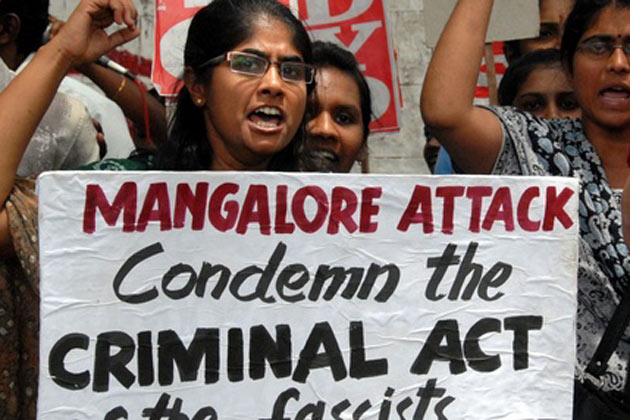
Moral policing, fundamentally, refers to the act of enforcing morality in individuals who engage themselves in, so called, ‘immoral acts’ and also to make sure others too don’t end up doing such things. The term morality, in today’s time and age, has different meanings for different people and hence moral policing has different repercussions for every person. As long as a person, consciously, intends on being morally policed is fine but when vigilante groups consisting of hypocritical people themselves turn to free the society from the shackles of immoral behavior, that’s where the problem begins. Liberating themselves from the grasp of age old customs and universality, which a noteworthy piece of the general public still denounces (the continuous strikes in bars and clubs being occurrences of it). Government officials have been a fundamental piece of the entire 'Moral Policing' drive which has been common in our nation for a long while now. They announce themselves to be the watchmen of the mass against the obscene and intemperance methods for the western world. Their point being to keep individuals from doing anything which is against our 'sanskaar'. In any case, then, I think, more likely than not been snoozing while watching porn in the Parliament was acknowledged as a piece of Indian Culture. I figure I additionally passed up a great opportunity for the way that a wedded couple kissing or holding hands openly was against the Indian culture, however assaulting a lady and abandoning her to bite the dust there in the city is absolutely justified. Appears like individuals of our era have a great deal of grounds to make up and need to get knowledgeable with the Indian society.

There have been multitudinous instances of government officials, exceptionally those having a place with the Right wing, who have openly made remarks which propose threatening vibe towards individuals, who they believe are shameless. On one hand they need people in general strive for an existence which is being lived in the west, however, in the meantime they feel that most of it is not suited to the Indian way of life. Aside from the legislators even the police have been effectively included in maintaining Indian values, the miserable part being the way they do so. Instances of imprisonment of individuals they attempted to be included in indecent acts, fining couples for kissing/holding hands out in the open or notwithstanding assaulting nonnatives for not paying reward as they thought they surpassed as far as possible for celebrating (Feb, 2014 in Gokarna). Even Articles 292 to 294 of the Indian penal code condemn acts of obscenity which include ‘condemning songs or acts which are obscene’. Though the ‘acts of obscenity’ are relative in nature and offend just a part of the society at a time.

People nowadays are well aware of the wrongdoings going around them in the name of morality and have been very active in raising their voices against it. The ‘Kiss of Love’ campaign which started in Kochi is a very good example of that. People took to the streets to raise their voices against the moral policing in India. Protestors hugged and kissed each other on the streets and this campaign slowly spread across various metropolitan cities like Delhi, Mumbai and Kolkata. The campaign, like expected, drew a lot of flak from political parties like the Shiv Sena which considered ‘public display of affection’ to be against the Indian value system and the law of land (Article 294 of the Indian Penal Code).

Statistics show that crimes like human trafficking and prostitution are more likely to happen in pubs, discotheques and selected eateries. But innocent people who go there to spend some of their free time don’t deserve to be manhandled and attacked. The function of the police is to uphold the law and order in the country. Employing such fear tactics without the requisite authorization (warrant) amounts to a gross abuse of power and a breach of the citizens’ Fundamental Rights; this should be dealt with firmly by the Judiciary.
In a country like India, such issues arise because choosing between tradition and modernity is like a choice between chalk and cheese. Some sections of the society are not willing to let go of traditional way of life and they are justified in doing that, but they should be prepared to digest the fact that modernization is inevitable and not come in the way of others who want to practice it. There is no sight that can be more pathetic than that of a do-gooder running amok. The police on its part should strive to uphold the law rather than do what they think is the law.

Asking a lady to mind her clothes when she come to the police station for lodging complaints against a band of hooligans, saying its against the Indian culture, by the police is also “Moral Policing”. Who has given the police or the so-called preachers of morality the freedom to curb the rights of others, when the constitution guarantees them the freedom to speech expression. It's often said that people who stay in glass houses shouldn't throw stones at others. These guys themselves indulge in thousands of illegal acts, sleep away with hundreds of girls against their will, that’s not illegal but a low caste boy marrying a rich higher caste girl is immoral and for that the boy is killed but no step is taken apart from political parties quarreling amongst themselves. The question that now arises is whether there is, at all, a need for moral policing? And if yes, then how should we go about it? The previous is an inquiry which will have a bunch of assessments and will dependably be a fervently point. We live in times of quickly changing flow of relations between two nations and if any of the nations' available itself in a manner that undermines the progressiveness of the other, in order to make them feel like awful impacts, then that may not be productive to the reason for their relationship. Numerous outsiders coming to India reconsider their decision before doing anything to not be trapped in the web of tricky profound quality issues of the Indian culture.
Regardless of the fact that we feel that ethical policing is fundamental, then going
about it the way we are will just compound the situation. Rebuffing individuals for things which were denounced route back in the 1800's (the Indian Penal Code was drafted in 1860) is not adequate in today's day and age. Until and unless we strike a harmony in the middle of progressiveness and our age old customs, the contentions between the two will bring about the masses being whimsical about the advancement of the nation and henceforth will dependably be inconsistent with the officials and gatekeepers of the law.

AUTHOR:-
Anurag Sengupta
This move comes as an astonishment considering the late proclamations by the Mumbai Police Commissioner Arup Patnaik backing ACP Dhoble for his activities and likens to a conceivable affirmation of his issue. In the meantime it has introduced a novel case before the general public, of the police going about as vigilantes, howsoever dumbfounding that may sound. Good policing has dependably been a delicate issue in India given the way that even in the 21st century; India hasn't totally made the move of mentalities going from moderate to advanced. Usually, political gatherings use good policing as a pawn for increasing political mileage as opposed to really following up on an arrangement of convictions. The assault on young couples on Valentine's Day by the Shri Ram Sena in Mangalore tells the grieved story.
Moral policing, fundamentally, refers to the act of enforcing morality in individuals who engage themselves in, so called, ‘immoral acts’ and also to make sure others too don’t end up doing such things. The term morality, in today’s time and age, has different meanings for different people and hence moral policing has different repercussions for every person. As long as a person, consciously, intends on being morally policed is fine but when vigilante groups consisting of hypocritical people themselves turn to free the society from the shackles of immoral behavior, that’s where the problem begins. Liberating themselves from the grasp of age old customs and universality, which a noteworthy piece of the general public still denounces (the continuous strikes in bars and clubs being occurrences of it). Government officials have been a fundamental piece of the entire 'Moral Policing' drive which has been common in our nation for a long while now. They announce themselves to be the watchmen of the mass against the obscene and intemperance methods for the western world. Their point being to keep individuals from doing anything which is against our 'sanskaar'. In any case, then, I think, more likely than not been snoozing while watching porn in the Parliament was acknowledged as a piece of Indian Culture. I figure I additionally passed up a great opportunity for the way that a wedded couple kissing or holding hands openly was against the Indian culture, however assaulting a lady and abandoning her to bite the dust there in the city is absolutely justified. Appears like individuals of our era have a great deal of grounds to make up and need to get knowledgeable with the Indian society.
There have been multitudinous instances of government officials, exceptionally those having a place with the Right wing, who have openly made remarks which propose threatening vibe towards individuals, who they believe are shameless. On one hand they need people in general strive for an existence which is being lived in the west, however, in the meantime they feel that most of it is not suited to the Indian way of life. Aside from the legislators even the police have been effectively included in maintaining Indian values, the miserable part being the way they do so. Instances of imprisonment of individuals they attempted to be included in indecent acts, fining couples for kissing/holding hands out in the open or notwithstanding assaulting nonnatives for not paying reward as they thought they surpassed as far as possible for celebrating (Feb, 2014 in Gokarna). Even Articles 292 to 294 of the Indian penal code condemn acts of obscenity which include ‘condemning songs or acts which are obscene’. Though the ‘acts of obscenity’ are relative in nature and offend just a part of the society at a time.
People nowadays are well aware of the wrongdoings going around them in the name of morality and have been very active in raising their voices against it. The ‘Kiss of Love’ campaign which started in Kochi is a very good example of that. People took to the streets to raise their voices against the moral policing in India. Protestors hugged and kissed each other on the streets and this campaign slowly spread across various metropolitan cities like Delhi, Mumbai and Kolkata. The campaign, like expected, drew a lot of flak from political parties like the Shiv Sena which considered ‘public display of affection’ to be against the Indian value system and the law of land (Article 294 of the Indian Penal Code).
Statistics show that crimes like human trafficking and prostitution are more likely to happen in pubs, discotheques and selected eateries. But innocent people who go there to spend some of their free time don’t deserve to be manhandled and attacked. The function of the police is to uphold the law and order in the country. Employing such fear tactics without the requisite authorization (warrant) amounts to a gross abuse of power and a breach of the citizens’ Fundamental Rights; this should be dealt with firmly by the Judiciary.
In a country like India, such issues arise because choosing between tradition and modernity is like a choice between chalk and cheese. Some sections of the society are not willing to let go of traditional way of life and they are justified in doing that, but they should be prepared to digest the fact that modernization is inevitable and not come in the way of others who want to practice it. There is no sight that can be more pathetic than that of a do-gooder running amok. The police on its part should strive to uphold the law rather than do what they think is the law.
Asking a lady to mind her clothes when she come to the police station for lodging complaints against a band of hooligans, saying its against the Indian culture, by the police is also “Moral Policing”. Who has given the police or the so-called preachers of morality the freedom to curb the rights of others, when the constitution guarantees them the freedom to speech expression. It's often said that people who stay in glass houses shouldn't throw stones at others. These guys themselves indulge in thousands of illegal acts, sleep away with hundreds of girls against their will, that’s not illegal but a low caste boy marrying a rich higher caste girl is immoral and for that the boy is killed but no step is taken apart from political parties quarreling amongst themselves. The question that now arises is whether there is, at all, a need for moral policing? And if yes, then how should we go about it? The previous is an inquiry which will have a bunch of assessments and will dependably be a fervently point. We live in times of quickly changing flow of relations between two nations and if any of the nations' available itself in a manner that undermines the progressiveness of the other, in order to make them feel like awful impacts, then that may not be productive to the reason for their relationship. Numerous outsiders coming to India reconsider their decision before doing anything to not be trapped in the web of tricky profound quality issues of the Indian culture.
Regardless of the fact that we feel that ethical policing is fundamental, then going
about it the way we are will just compound the situation. Rebuffing individuals for things which were denounced route back in the 1800's (the Indian Penal Code was drafted in 1860) is not adequate in today's day and age. Until and unless we strike a harmony in the middle of progressiveness and our age old customs, the contentions between the two will bring about the masses being whimsical about the advancement of the nation and henceforth will dependably be inconsistent with the officials and gatekeepers of the law.
AUTHOR:-
Anurag Sengupta


